Showing posts with label Barrage. Show all posts

Friday, August 29, 2025

Working on my WW1 Collection - Artillery & Infantry

Over the years I have accumulated a lot of 15mm WW1 miniatures. Nearly every flea market at Historicon I have found a nice amount of WW1 miniatures. This year was no different. Since I'm retired now, I have time to finally work on this collection.

ARTILLERY

The last few months have seen a lot of progress, including rebasing artillery from Germany, Britain, and USA. Here are some photos of the process. Note I haven't flocked any of the bases yet, but all bases labeled on the bottom so that they can be identified by those not familiar with WW1 artillery.

6 x 75mm Gun M1879 (USA) (French gun)

3 x 155mm Mle 1917 Howitzer (USA)

4 x FT17 (USA)


3 x 18pdr Field Gun (ANZAC)

8 x 18pdr Field Gun (Britain) - roughly 12 more unpainted.

British 18pdr Field Gun

2 x 6" 26cwt Howitzer M1989 (Britain)

2 x 6" 26cwt Howitzer M1916 (Britain) - two more unpainted.

1 x 60pdr MkI (Britain) - Handmade by Mal Wright

1 x 8" MkII Howitzer (Britain) - Handmade by Mal Wright

Top is 8" MkII and the 60pdr is on the bottom.

1 x 15cm FK16 Lange Kanone (Germany) - Handmade by Mal Wright!

1 x 21cm Lange Morser M1916 (Germany) - Handmade by Mal Wright!

1 x 15cm Lang M17 Howitzer (Germany)

Left:15cm FK16 | Right: Morser M1916

9 x 7.7cm FK96nA Krupp Field Guns (Germany) - still a lot more to paint

5 x 7.7cm FK16 Krupp Field Guns (Germany)

4 x 10.5cm FH 98/09 Krupp Howitzers (Germany)

1 x 13.5cm K 1909 (Germany) - Handmade by Mal Wright!

2 x 15cm sFH13 Krupp (Germany) 

1 x 10cm K17 Krupp (Germany) - Handmade by Mal Wright!


2 x 15cm sFH02 Krupp (Germany) 

1 x 7.7cm IG16 (Germany) - Handmade by Mal Wright!

1 x 5cm IG15 (Germany) - Handmade by Mal Wright!


That is 59 guns so far! Wow! I still have to do the French, Belgians, Russians, and Austrians. I eventually need to finish painting the rest of the unpainted artillery (maybe 24 more guns). Crew will be added as they are painted.

I also decided to use round discs to represent forward observers in the games. I don't have any good miniatures for that roll, and FOs just need to be represented on the table. I made FOs for Germany, USA/UK, Austria, Russia, and France.


INFANTRY

Also, I have based, but not flocked the following WW1 infantry:

Early War Germans (12 Regiments, plus 2 Brigades of Landwehr, 20+ MGs) I keep my WW1 infantry in map chest draws with each division on its own tray for easy access.


Early and Late War British (11 Brigades)


Early and Late War French (4 or 5 divisions, EW not shown)


Late War USA (2+ Divisions)


I have so much work to do on this collection, but I'm making progress! Happy Gaming!

Eric

Sunday, June 7, 2020

RJW - Japanese Imperial Guard Division, 1st Army


The Imperial Guards Division is the second division I've completed painting and fielding for my Russo-Japanese War games. Most of the figures were already painted when I bought them, but I had to rebase, flock and do some touch-up painting to prepare them for battle. It was quite a lot of work.
  
The Imperial Guard was part of the Japanese 1st Army and fought in the following engagements during the war: Yalu RiverMotien Pass (Motienling), LiaoyangShaho, and Mukden. The division fought in all major engagements outside the Port Arthur siege\assault.

The Imperial Guard uniform had red cap band and red collar, while the LINE regiments had yellow cap bands and yellow collars. These figures are in the early war winter dark blue uniform but the Guard Cavalry is in the khaki uniform that was issued later. All regiments and brigades are color coded on the back of the base for easier identification during a game.

Infantry figures are 95% Frontier miniatures (15mm), while there are a scattering of Irregular miniatures throughout the commands stands. One command stand has Falcon USA figures in it, which are very nice. Artillery is from the Really Useful Guns range sold by Irregular Miniatures. Cavalry figures and their dismounted counterparts are also from Irregular miniatures. Flags were made from clipart, and touched up to add blue-ish outline, which I then touched up with paint.

The commander of the Japanese Imperial Guard is Lieutenant General Hasegawa, and he was in command of the Imperial Guard throughout the war. He can be seen in the photo below.


Below is General Baron Hasegawa in front of the artillery regiment.

Imperial Guards Division (1st Army) Order of Battle

Commander: Lieutenant General Hasegawa

1st Brigade: Major General Asada
     1st Guard Infantry Regiment (3 battalions of 4 companies each)
     2nd Guard Infantry Regiment (3 battalions of 4 companies each)

2nd Brigade: Major General Wabanabe
     3rd Guard Infantry Regiment  (3 battalions of 4 companies each)
     4th Guard Infantry Regiment (3 battalions of 4 companies each)

Attached:
     Guard Artillery Regiment (36 guns) 6 batteries of six 70mm Arisaka Field Guns (Col. Kumamoto)
     Guard Cavalry Regiment (3 squadrons) (Lt. Col Kasa)

Entire Guard Division


1st Brigade on Parade


Major General Asada, commander of the 1st Brigade, Imperial Guards:

Below is my version of Major-General Asada of the 1st Brigade along with his regimental commanders:


2nd Brigade on parade:


Major General Watanabe, commander of the 2nd Brigade, Imperial Guard:


More of the 2nd Brigade, 3rd and 4th Guard regiments


Guard Artillery Regiment, six batteries (stands), with 6 guns per battery.


Colonel Kumamoto, commander of the Imperial Guard Artillery Regiment (figure on round base above):


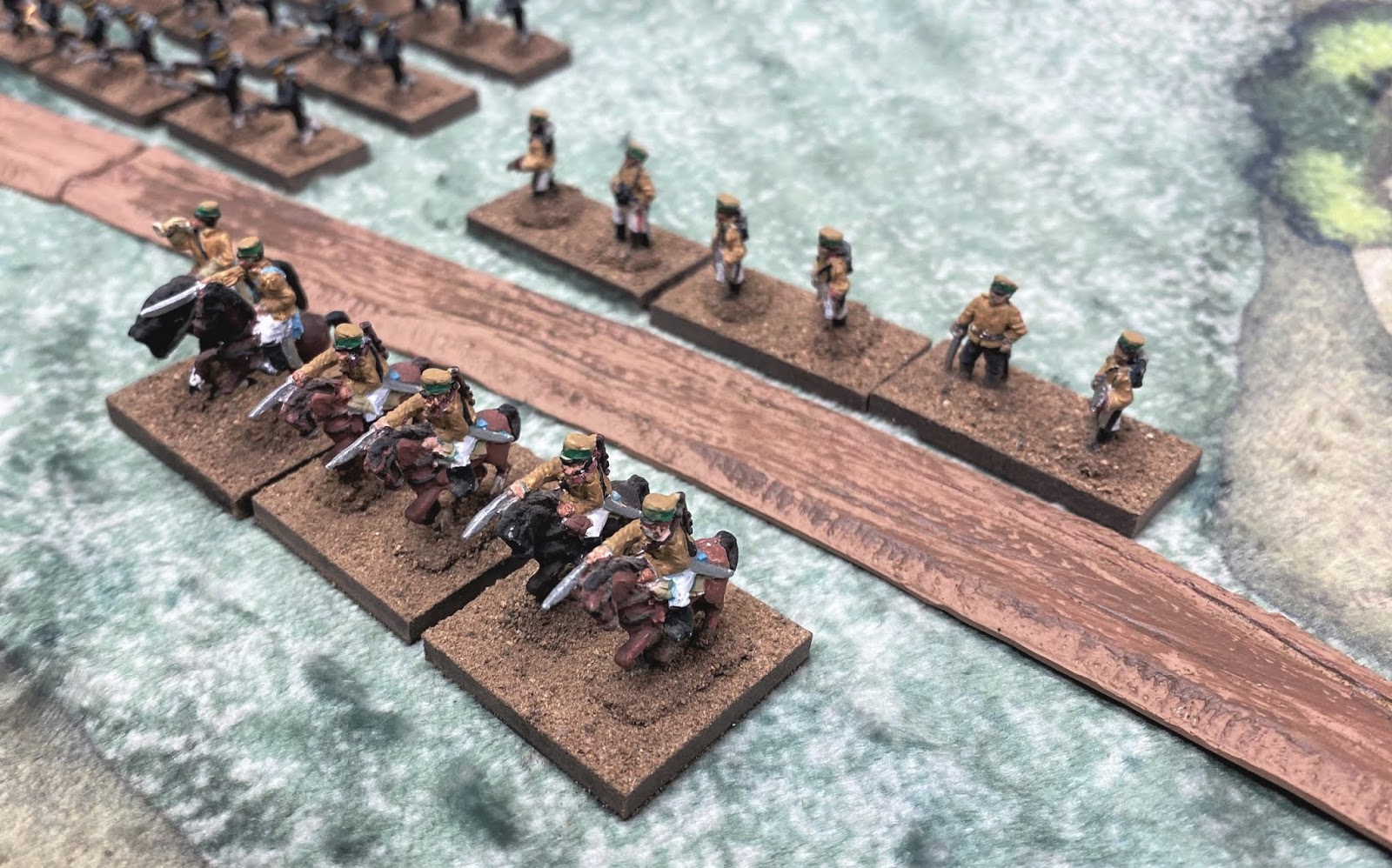
Guard Cavalry Regiment, with dismounted stands. Cavalry regiments attached to the division were small 3 squadron regiments of about 300 men per regiment. I gave this regiment a Hotchkiss MG too.


That is my Japanese Imperial Guard Division! So excited to get them on the table!

Japanese 2nd Division here.
Japanese 12th Division here (tbd)

Sunday, April 12, 2020

RJW - Japanese 2nd Division, 1st Army

   My fascination with early 20th century warfare continues with the Russo-Japanese War (1904-1905) land warfare. I have nearly assembled everything I need for this collection and I'm going to start posting my Japanese Army divisions and first up is the 2nd Division of the First Army!

   The 2nd Division is the first division I've completely painted and is ready to take the field for my games. Most of the figures were already painted when I bought them, but I had to rebase, flock and do some touch-up painting on them to prepare them for battle. (much more work than I thought)
  
   The 2nd Division was part of the Japanese 1st Army and fought in the following engagements during the war: Yalu River, Motien Pass (Motienling), Liaoyang, Shaho, and Mukden. The division fought in all major engagements outside the Port Arthur siege\assault.

   I will be able to use the 2nd Division as a proxy division for other divisions if needed. I will field units for the 3rd and 15th brigades, along with the attached assets, plus Telegraph and Medical detachment.

Not to stray too far off, but my blog has just now crossed over 400,000 hits, which I think is pretty cool for a blog about wargaming. Thanks to everybody that has dropped by over the years!

Click on photos for larger versions.

General Baron Nishi, commander 2nd Division, 1st Army


"If I were asked to name the chief characteristic of the Japanese Infantry, I should say that it was its tenacity."
-- Major Joseph E. Kuhn, US Military Observer attached to the Japanese 2nd and 3rd Army


3rd Brigade Commander: Major General Matsunaga


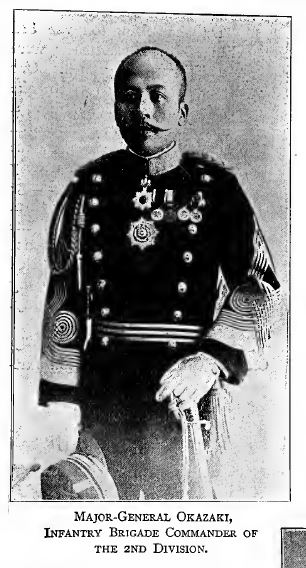
15th Brigade Commander: Major General Okazaki


2nd Division on Parade


OOB Japanese 2nd Division

2nd Division: Lieutenant General Nishi
     3rd Brigade: Major General Matsunaga
          4th Infantry Regiment (3 bns, 4 companies each) - Lt. Col. Yoshida

          29th Infantry Regiment (3 bns, 4 companies each) - Col. Shimada 
     15th Brigade: Major General Okazaki
          16th Infantry Regiment (3 bns
, 4 companies each) - Col. Taniyama
          30th Infantry Regiment (3 bns, 4 companies each) - Col. Kawasaki 

Attached:
     2nd Artillery Regiment (36 guns)

          2 battalions, 3 batteries each, six guns per battery - Colonel Tada 
     2nd Cavalry Regiment (3 squadrons) - Lt. Col. Akiyama
    

Support:
Ammunition Columns (3 artillery, 4 infantry)
Medical Detachment
Pontoon Train
Telegraph Detachment
2nd Engineer Battalion
Provisions Columns
Horse Depot
Field Hospital

Source: British General Staff, The Russo-Japanese War, His Majesty's Stationary Office, London, 1906-1908.  


Originally, I was going to field the Engineer\Pioneer Battalion, but later read that they never really fought as a battalion, so I'm going to use them to fill out the 12th Division's forces.

A Japanese division is roughly 14,000 combatants and 36 guns (plus 6000 non-combatants).

Using BARRAGE basing, each infantry battalion is 12 figures on 4 bases. Standard basing is 3 figures on a 1.5 x .75 inch base. Each regiment would have 38 figures, which includes three 12 figure battalions figures and a two figure Regimental command stand.

2nd Artillery Regiment


2nd Cavalry Regiment
3 squadrons, and 3 dismounted stands


 3rd Brigade: Major General Matsunaga
          4th Infantry Regiment - Lt. Col. Yoshida (Irregular Miniatures - summer khaki)


          29th Infantry Regiment Col. Shimada


Each regiment has a unique color label.

15th Brigade: Major General Okazaki
          16th Infantry Regiment  - Col. Taniyama
          30th Infantry Regiment Col. Kawasaki 

Frontier miniatures for the infantry regiments


MARCHING SONG OF THE 9TH REGIMENT
Part of the 4th Division, 2nd Army

(This Regiment is mainly composed of men from the province of Omi, and the shores of Lake Biwa. The original was composed by Lieut. Umemoto, the " poet-lieutenant.") NOTE: almost sounds like an Iron Maiden song!

The bugle sounds, the war begins,
The war that's to punish the Russians' sins

Our Emperor calls us and bids us fight,
In his behalf for Justice and Right.
So forward march my comrades brave,
Let us face the Russians nor fear the grave


Chorus. 
We'll die if need be, but
we'll ne'er disgrace
The flag of our country,
the pride of our race :
Our colours shall lead in
the onslaught's van,
As becomes the pride of the
brave Omi clan.


...


Hope you enjoyed!

Japanese Guard Division here.
Japanese 12th Division here. (tbd)

Friday, March 10, 2017

RJW - Battle of Fushun

G'Day!

Last night my crew and I fought a Russo-Japanese battle pitting the Japanese 2nd Division from the 1st Army, against the 3rd East Siberian Rifle Division of the Russians.

The 2nd Division had assistance from one brigade of the Japanese Imperial Guard! That two more regiments with 6 more battalions of elite infantry to attack the entrenched Russians. I took over 100 photos of the game, but I'm only going to put about 25 to 30 in this post as we will be refighting this battle again next week.

Figures: 15mm from Eric's collection
Rules: playtesting battalion scale of Barrage (Piquet supplement)
Terrain: Mal made the Chinese buildings and they look awesome!

The commanders ...

Japanese 2nd Division (3rd and 15th Brigades) - Eric C.
Japanese Imperial Guard Brigade - Paul
Russian 1st Brigade - Phil
Russian 2nd Brigade - Jan

I was the umpire as I'm breaking in some new rules.

Click below to see the orders of battle for each side along with the morale chip totals.


Here are a couple of photos of the battlefield (Russians defending a series of ridge lines) before the game began. This is the view from the Russian side of the battlefield. Most Russian battalions are entrenched, while the Japanese are in extended formation, getting ready for the advance across the valley. I labeled the photo to show where each command is located.


Lieutenant General Zasulich - 3rd East Siberian Rifle Division survey's the ground. Will his Siberians hold against the much larger Japanese army? The cherry blossoms are in bloom!


We are ready pa-pa!


Here you can see the 9th East Siberian Rifle Regiment entrenched overlooking Fushun and the Kialiang fields. These fields are 8 to 10 foot high and provide concealment (DOWN1) for units moving through them.


Period photo of Kialiang fields


The Japanese commanders met and decided to lead the attack with artillery barrages from the 9 supporting batteries and let the 2nd Division's two brigades launch their attacks first, with the Imperial Guard slightly delayed.

The prime artillery target for the 2nd division was in from of the Japanese 16th regiment on the Russian far left. Thirty six guns (or six batteries) opened up on the Russian trench line to the left of Fushun. Eventually that artillery would destroy the battalion manning the trenches there.


Found these two extra photos showing the effects of the bombardment and the Japanese assault on the empty trench line:


All across the front shrapnel rained down from Japanese batteries, and the Japanese infantry started their advance. Here is the 16th Regiment moving towards the pounded Russian lines.


As the Japanese 16th and 30th regimented advanced on Fushun, the Russian's opened fire with a battalion from the 10th ESRR that was hidden in Fushun. (Due to Phil's terrible rolling as the Russian commander on the left wing, little damage was done) The Chinese market in Fushun will never be the same!!


Paul sends his Imperial Guard brigade into battle. Here they are wading through a shallow but broad steam in front of the 21st and 34th ESRRs.


In the center Eric has advanced his Japanese 4th infantry regiment (in their new khaki uniforms!) into the Kialiang fields, while the Russians have taken 2 stands of damage on the far left battalion, the commander will have to check for survival (heart), and all the Russian units have fired (shell casing).


The Japanese 30th infantry regiment reaches Fushun and attack the Russians with bayonets!


Japanese 16th regiment rushes forward. See the empty trench (just Russian dead bodies there), and the other Russian unit has two stands lost already!


Overrun! Japanese move through the Russian trenches and Russian commander, Colonel Schwerin, dies on the field.


The Imperial guard reaches the river, but now the Russian guns start to find their range.


In Fushun, the Japanese are routed out of the town, but the next Japanese battalion pushes out the Russians.


Getting up-close and personal in the center as the 4th and 29th Japanese regiments come to grips with the Russia 9th ESRR.


Russian reserves heading to the trenches at the Japanese 4th pushes one battalion of Russians out of their trenches.


Russians launch a counter attack against Fushun, and push back the Japanese. Too little too late.


Japanese 16th regiment sweeps into the flank of the Russian 10th ESSR battalion and charge towards the Putilov Fields guns.


More fighting near Fushun.


The guns are overrun by the Japanese!


On the other flank, three Imperial Guard battalions are routed by Russian artillery fire! The shame!


Reforming in the center to hit the 34th ESRR.


Cut down! Russians are massacred by the Japanese crashing into their unprotected flank.


Little hope for the Russians now.


There may be a new Japanese Imperial Guard commander next week. :-)


At this point the battle was over. The Russian left flank was completely rolled up, their center was about to break, and the right was just about to get attacked by the Imperial Guard. The following photos show the situation at the end of the evening. All from the Japanese point of view.

The Japanese 16th and 30th regiments overwhelm the remaining units from the 10th ESRR.


Japanese 4th and 29th push in the center.


Not much left on this sector of the battlefield for the Japanese.


Japanese Guard is ready to finish off the 21st ESRR


Final shot of the center and my homemade Japanese flags for this period.


We had a fantastic time and will be fighting this again next week. This is really a typical RJW battle as the Russians were on the defense in trenches while the Japanese attacked. Later in the war the Japanese would switch to night attacks as these became too costly.