DAY1 - The Landing and the Catholic Mission
[Probably a good idea to keep the campaign map open in a different Window so you can switch back and forth to look at the map and the text.]
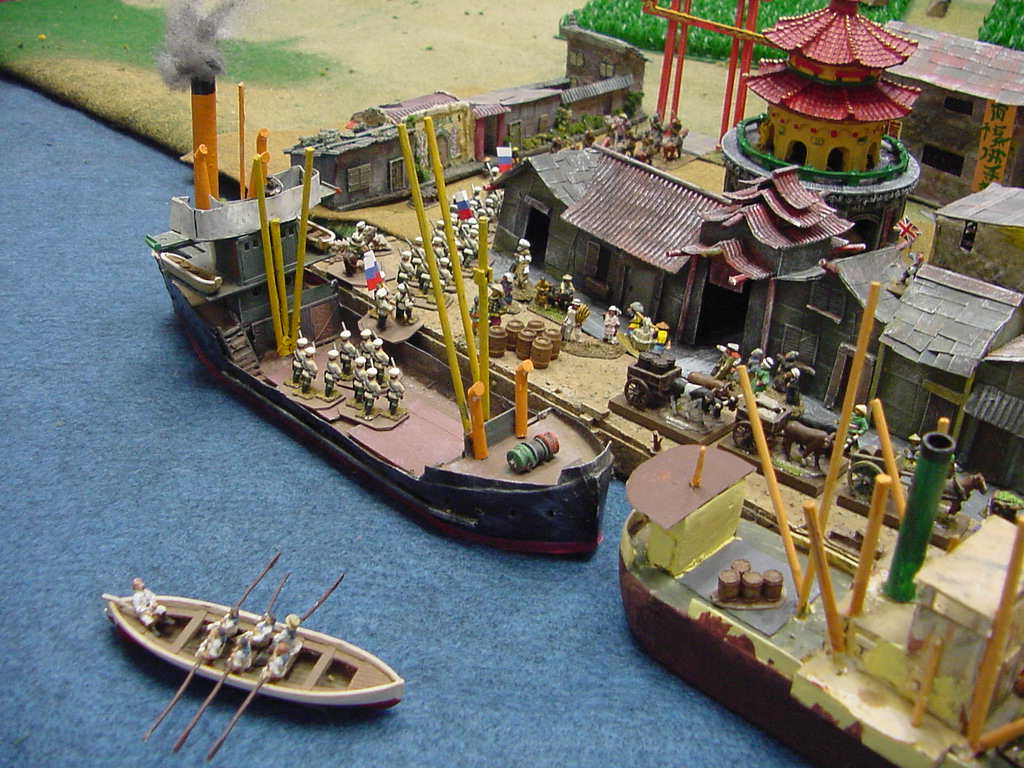
The international fleet arrived at WEI LUNG HOO and began disembarking at 6:30AM. The Americans and Russians were the first off the ships, followed by the Germans, French and Italians. Foodstuffs, ammunition, and medical supplies were unloaded and put into wagons for the operations into China.
US and Russians Landing in WEI LUNG HOO:
WEI LUNG HOO is a seaport of recent construction, built by Western Traders. It has docks to handle several steam ships and the buildings are mostly of western style, with some Chinese Merchant buildings as well. The arrival of the international forces did cause some crowds to assemble to watch the proceedings, but little excitement was generated from this “invasion”.
The Americans immediately sent their 3rd Cavalry regiment on patrol in the areas surrounding WEI LUNG HOO, while the rest of the contingent disembarked. They scouted to the south along the German East Asian Railway line and down the Imperial Road to PIATSUNG. The railway and the town were clear of hostile Boxer forces and the 3rd US Cavalry returned to their position of screening the US & German column that was marching down the German East Asian Railway.
Because of a desire for a rapid rate of march the Germans and Americans left their supply wagons (ammunition and food), along with a battery of US guns and 2 battalions of German Marines (Seebatallion), in WEI LUNG HOO so they could make better time going down the railway line. The German hope that there would be railroad cars waiting in WEI LUNG HOO to take them south was quickly dashed when they landed and found the railroad yard empty, but undamaged. The German and US supply wagons would make their way down the Imperial Road when summoned by their commanders. The soldiers had ammunition and food on their persons to sustain them for about two days.
Meanwhile, the Russians waited for the French and Italians to unload completely before heading off down the Imperial Road. The Amur Cossacks were sent ahead of the column to scout for Boxer activity or hostile Imperial Chinese forces. They reached the previously cleared village of PIATSUNG. Originally a farming village it is now a tin shanty town housing workers for the docks in the western controlled town. It was originally a town with mud walls but these have fallen into disrepair and only cover some sections of the village.
The Amur Cossacks, the lust for battle being up after breaking into the vodka stores on the ships, took it upon themselves to teach the Chinese a lesson in Cossack Warfare and PIATSUNG was their unfortunate victim. They proceed to burn several of the dilapidated houses and executed about a dozen Chinese who attempted to put up resistance as an example to all Chinese that resisted their advance.
Italians marching past Cossack handy-work in PIATSUNG:
General Boris Konnellovski upon seeing the smoke rising from PIATSUNG and hearing of the barbarity of the Amur Cossacks, flew into a rage which meant there would be hell to pay for those drunken Cossacks. The wrath of the general would be seen in the morning. The Amur Cossacks, worthless in their current state, were ordered to the rear of the allied column.
The rest of the march by the Russian, French, and Italian forces to WENPO was uneventful, although the Russian troops leading the column outpaced their allies causing the column to become broken and arrived an hour or two ahead of the French and Italians. WENPO is a prosperous walled Chinese farming town which supplies the larger nearby town of SI-LIAN and the western town at WIE LUNG HOO. Originally a poor village its prosperity has increased greatly since the arrival of western traders. Its farms are mostly wealthy and it is considered more loyal to the westerners than the Chinese Government. The rear of the column finally arrived around 8PM and camp was made outside the town’s sturdy walls.
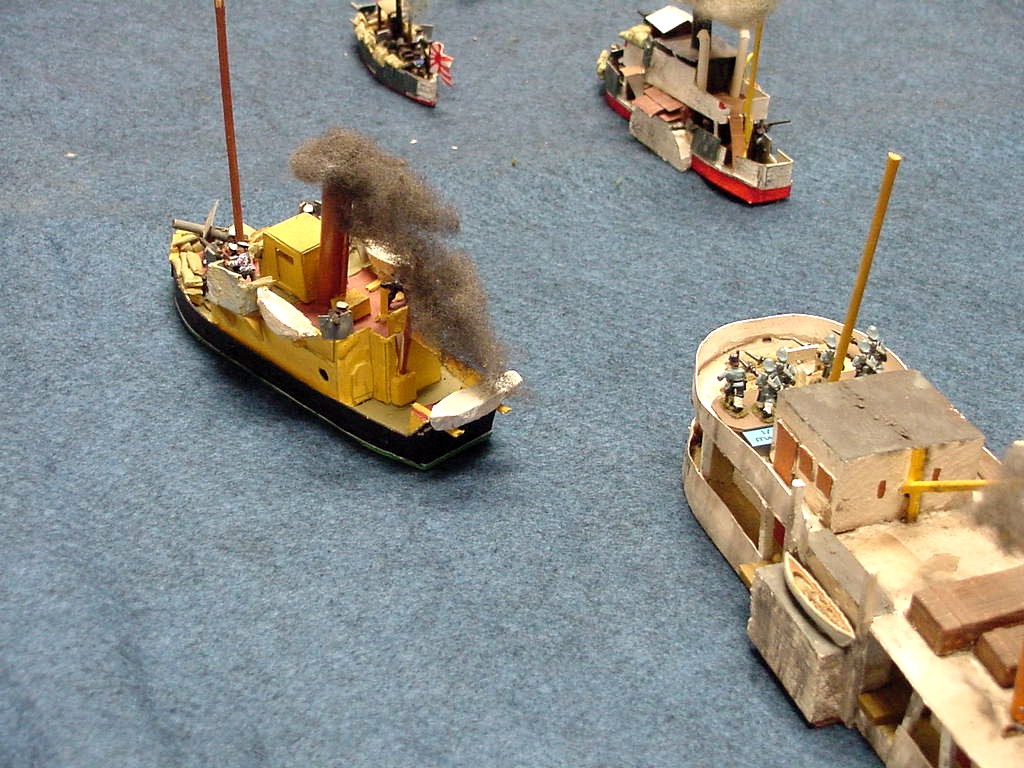
During the morning of unloading the French, concerned with the welfare of the nuns at the Catholic Mission (H4) near FONGSUN, decided to assemble a Catholic Mission Task Force. This French lead mission to rescue the nuns and westerners at the Catholic Mission included the French 1/11th Marines & 1st Annamite-Tonkinese Regiment loaded on the Gurbett Troop transport, and escorted by the Russian Gunboat Prince Vladistov, Japanese ships Tone, Sendai, and Shirataka. The HMS Kangaroo would also provide protection around the mouth to the KANSU WO INLET. The two battalions embarked on the Gurbett carried extra food stuffs and ammunition for this operation.
Part 4 will be the Battle of Si-Lian (Boxers vs. Germans and USA)
Wednesday, February 2, 2011
Boxer Campaign - Planning the Plan - Part 2 of 12
DAY0 - Planning to Plan
The commanders arrived on the Japanese flagship to discuss the operations. The fleet was anchored several miles off the coast, north of WIE LUNG HOO. The Russia, French, Italian, and German generals had their best dress uniforms on with medals and ribbons in prominent display. General Hood of the US Army arrived in campaign fatigues and just rolled his eyes at the peacocks on parade. The Japanese Admiral Kramaguchi was incapacitated with a severe case of gonorrhea and was unable to attend the meeting. Oddly he sent no replacement for himself.
The generals, colonels, and orderlies scurried about the Admiral’s planning room and eventually sat down with maps, drinks, and agendas. General “Mad Dog” Hood decried the need for speed to the Western Trading Station, while saving as many Westerners as possible. The French, under the guidance of Genereaux Eric du Cottrell, were concerned about the Western Trading Station, but urged the plan of a second operation to save the nuns at the Catholic Mission as soon as possible. Field Marshal Ludwig von Bolling the German commander, wanting total control as usual, asked to be named overall commander of the land forces, but was hushed into silence by the other generals. The Germans pressed the need to land without opposition and as little damage to property as possible. They had economic interests to protect. General Boris Konnellovski the Russian commander, voice slurred from too much excellent vodka, said his forces would only support an immediate advance to save the Western Trading Station. The Italians, led by Conte de Milan, Generale Adolfo Modladatii, where just happy to be there. The Italians were willing to guard the rear of the column if necessary; otherwise they were content to do what the others planned.
As plans were discussed around an advance down the Imperial Road and the East Asian Railway, it was observed during the meeting the General Konnellovski began to become increasingly concerned. He would look at his map, then look at the other generals, then back down at his map. He even had to put down his glass of vodka and grab the map with both hands. “Where is the railroad?”, he blurted out after several more minutes of staring at his map and hearing of a plan to take rail cars from WIE LUNG HOO to SI-LIAN. Everything became silent then laughter broke out among the group. Apparently the Russians had maps from the 1870s and theirs didn’t have any railroads on them!!! Russian lackeys quickly ran over to the other general’s maps and drew the railroad on the Russian map for future use.
After hours of discussion is was decided that the majority of forces would disembark at WIE LUNG HOO. The German and American forces would disembark and advance down the German East Asian Railway tracks towards SI-LIAN. The Russians, Italians, and most of the French would march down the Imperial Road to WENPO. [See Queng Lui map, top left corner of the map]
The French also garnered international support from Japanese, Russian and English ships to help them secure the Catholic Mission near FONGSUN in the KANSI WO INLET.
Labels:
Boxer Rebellion,
Colonial,
Terrain
Boxer Campaign - The Beginning - Part 1 of 12
Boxer Rebellion Campaign
1900 - 1901
by Eric Burgess
Fought from August 2005 to January 2007 in Charlotte North Carolina.
This is a cooperative\competitive campaing game, where the players are all members of the Allied Internation Relief force composing German, USA, Italian, Russian, and French contingents, while the umpire controls the Imperial Chinese and Boxers. The allies have some objectives that are the same, but many secondary objectives that are not. They also have limitations and restrictions that other commanders will be unaware of. Here is a list of the players and their commands:Players
Naval Commander (Japanese) - Admiral Marcusi Kramaguchi – Mark Cramer
French Commander - Genereaux Eric du Cottrell - Eric Cottrell
USA Commander - General Hal “Mad Dog” Hood – Hal Hood
Russian Commander - General Boris Konnellovski - Brian Connolly
Italian Commander - Conte de Milan, Generale Adolfo Modladatii – Jake Modla
German Commander - Field Marshal Ludwig von Bolling - Mike Bolling
Boxer\Imperial Chinese commanders in battles- Mike Johnson & Mark Cramer
Umpire and Chinese strategic campaign control - Eric Burgess
This campaign is inspired by Mal Wright, who is a great friend and excellent terrain maker, modeller, and game master. I will be using his map and provincial write-up for the fictional Queng Lui Province for the game background, with additional updates and modifications made by the umpire. I will also be using a great deal of buildings, terrain, and ships that Mal has created over the years and will finally be put into service here in Charlotte.
Rules are generic for the campaign, with some rules etched in stone while others will be free flowing. The campaign is designed to be short in duration in hopes that the campaign can be done to conclusion. Battles will be fought on the table-top using Piquet's Din of Battle Colonial rules with modifications.
Go to PART 2
Labels:
Boxer Rebellion,
Colonial
Tuesday, February 1, 2011
Epic 40K Rebirth...
When I was a mere lad my first miniatures were Games Workshop's Epic Space Marines line of figures. I bought into the background and bought Space Marines, Imperial Guard, Orks, Eldar, Tyrannids, and Squats. I played dozens of games of Epic, but just wasn't thrilled with the direction the rules were going by the time Titan Legions hit the market. Too many exceptions and special rules, along with GW's Power creap. Seems every new race had even more power weapons and features.
It was a good thing while it lasted.
I finally put Epic on the shelf and haven't had a battle since the 1990s. Even sold off my Orks and Squats thinking I'm eventually going to sell the rest.
The other night I was reading through Piquet Inc's ruleset called Field of Battle: World War 2 (FOB:WW2), and realized I could make a company based game using Epic figures!
The thrill of using my large epic collection again really pumped me up!
Epic is about squad level games (each unit is a squad or single vehicle), while FOB:WW2 is company based. Each infantry unit is a company and each vehicle unit is a company.
So right now a company is 6 ot 8 Epic figures (depending on the size of the figures), and each vehicle company is represented by two vehicles on a base. This looks particularly cool.
I'm using Flames of War bases I had accumulated from another failed miniatures project. (Need to buy some more now!)
Here is how I see my armies fleshing out. I have Space Marines (several chapters), Eldar (several different legions), Imperial Guard (several armies), and Tyrannids. This should give me lots of different troop types and scenario possibilities:
Space Marines - Ultra Marines (painted and rebased)
Space Marines - Overload Marines (my own chapter name, painted and rebased)
Space Marines - Blood Angels (needs to be painted, but 6mm is soooo easy to paint)
Eldar Host - yellow\orange color
Eldar Host - Purple color
Eldar Host -
Eldar Specials - Battalions of Striking Scorpions, Howling Banshees, Fire Dragons, Exarchs, etc.
Imperial Guard Army - Green Color
Imperial Guard Army - Grey Color
Imperial Guard Army - Undecided color
Tyrannid Army!
This should really make gaming much easier with Sci-Fi, because at company level you can really abstract a lot of stuff.
Cheers!
Eric
I hope to post some photos of the new basing once I get some of them flocked.
Labels:
Epic FOB
Subscribe to:
Posts (Atom)